Here is an excerpt from Mireille
Guiliano's latest book,
French Woman For All Seasons: A Year of Secrets, Recipes, and Pleasure. I found this part of the book to be the more helpful and easy to
implement in my life. I have been trying to mindfully follow the
50 Percent Solution each time I eat. I have noticed that I no longer feel stuffed once we leave the table... now, if only I can be this
disciplined at our Thanksgiving meal!
The 50 Percent Solution
"If, as one critic commented on French Women Don't Get Fat, it's "all about portion size" - it's not, really, but if - then change indeed is a tall order. It's generally known that Americans on average eat 10 to 30 percent more than we need to every day. This is not such a surprising result of an increasingly knowledge-based economy, in which jobs of many individuals involve sitting all day. It is simple deductive reasoning to connect this situation with the fact that Americans are also on average 30 percent above their ideal weight. It was a sixteenth century Frenchman, Montaigne, who rightly observed that gluttony is that source of all our infirmities. In the land where there's honor in being able to eat the most hot dogs, what is one to do?
Portion control is more and art than a discipline, one grounded in a useful bit of self-deception. I have written about the power of incrementalism, cutting back portions over weeks and months as you introduce new variety. Though very simple, the method sometimes requires a scale and can be a bit too unstructured for some.
One trick I use to control my intake is to ask myself if I can live with half the amount being offered; indeed, will I be just as happy eating half as much? I put this approach into play in a variety of different ways, from splitting dessert with my husband to counting the number of pieces of bread I eat at a restaurant (Bread is one of my "offenders," a food I'm particularly vulnerable to overeating, and I can mindlessly eat three or four slices if i don't pay attention.) I use this simple alternative regularly, especially when not sure about the "hidden" ingredients of what I've been served or when the portion I've been offered is obviously large. I eat half. Slowly, of course, chewing well. I then ask myself whether I'm content, and therefore whether continuing would be a matter of pleasure or merely routine."
"Often I do continue eating, but I have only half of the half that's left. Then, after pausing, I consider half of what's left again. Edward calls this my Zeno's Paradox of portion control. To paraphrase the ancient principle, if you continue eating only half of what's on your plate each time, you will never eat the whole thing. That's a theoretical explanation. I'm content to call it the 50 Percent Solution and think more practically about why it works. The act of stopping and reflecting slows down consumption, allowing the brain to catch up with the stomach and release the hormone that tells us, "Mmm, that was good, but I've had enough." Contentment is largely a matter of the clock - not how much you ingest but also what you've eaten during a given interval.
If you implement the 50 Percent Solution routinely, your sense of a satisfying portion is bound to shrink. I've been doing ti so long it even works on a banana."
Painting: Picking Fruit By Georges Lemmen

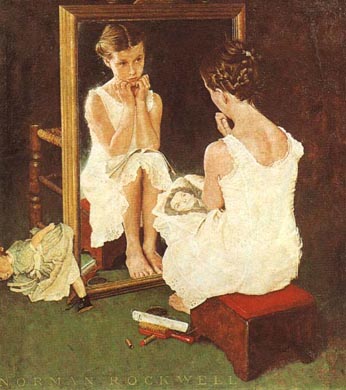
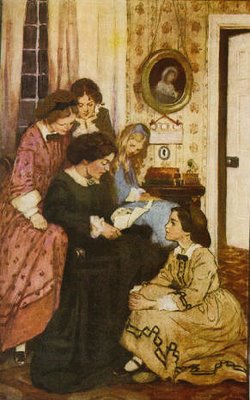
 I have been thinking a lot about guiding little girls in becoming feminine ladies... especially my little girl. I began thinking about this because of a conversation I had with my father-in-law and my mother-in law. My husband's father and I were discussing how excited we were about seeing the baby with bows and barrettes in her hair (when she gets some!). I expressed how much I enjoy dressing her up in little jumpers, tights, and other girly items. My father-in-law thought that this was great, but my mother -in-law wasn't so sure. She felt that doing this would "force" E. into becoming a girly-girl. "What if she wants to be a tomboy and isn't interested in wearing things like that or doing her hair?" I had no answer to her query.











 Yesterday was a bit cloudy with rain showers off and on, but that didn't deter me from taking the baby for a long Fall walk. As we ambled along the roads around our home, the smells of a cool, autumn day were all around us. Someone was warding off the chill by using their fireplace and we enjoyed the scent. We were so worn out