Saturday, January 23
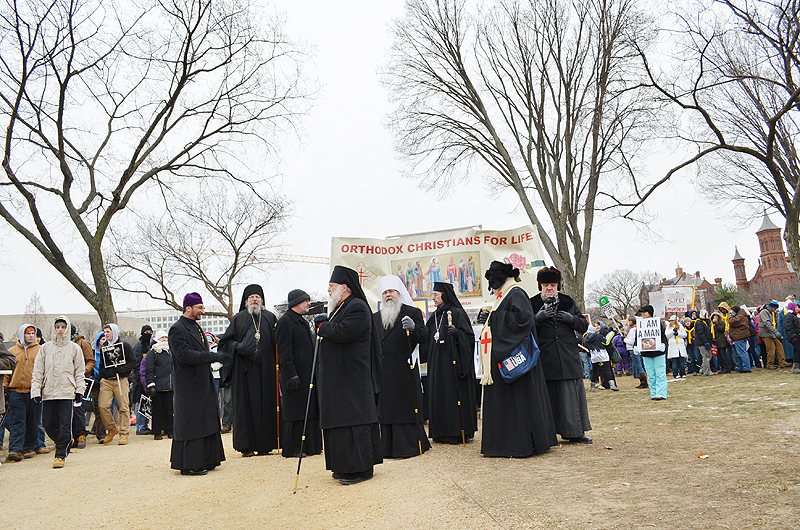
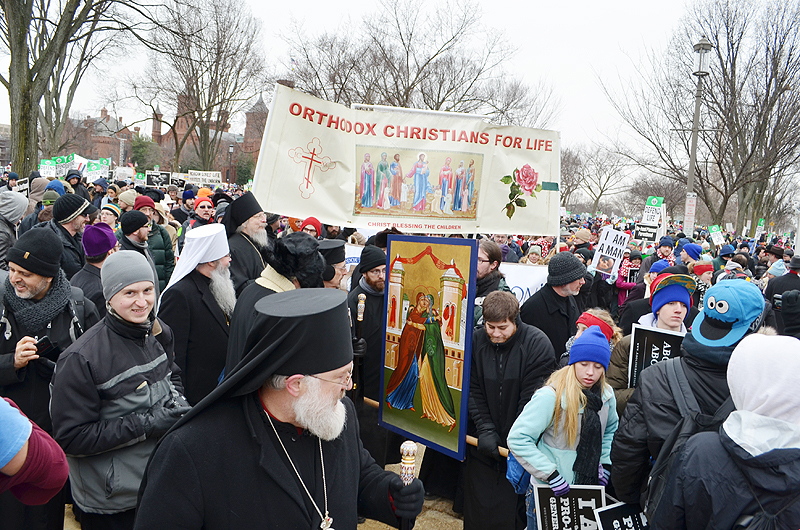
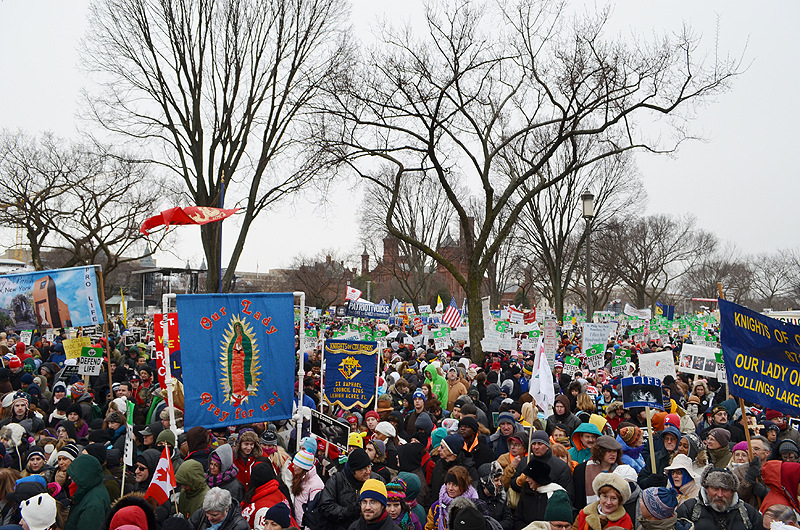
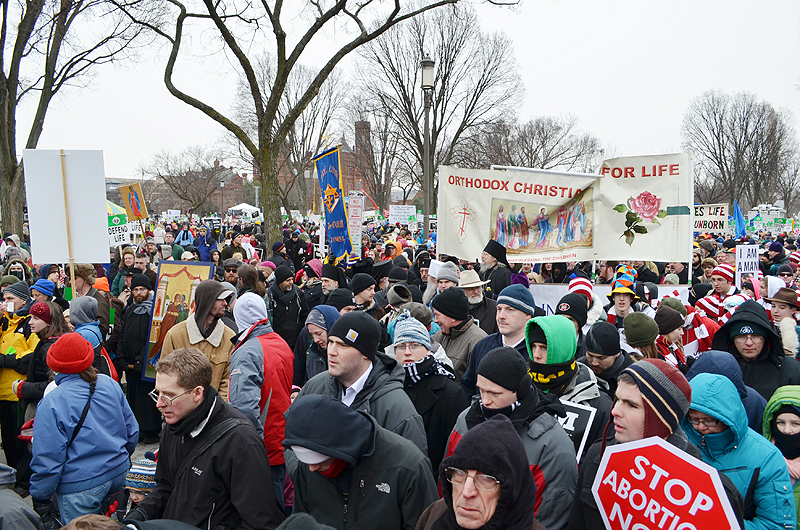
The 2016 March for Life...
Friday, January 22
The Greatest Destoyer of Love and Peace...
Monday, January 18
The Rights of Mankind...
Monday, January 26
2015 March for Life...
Thursday, January 22
Sunday, January 18
Sanctity of Life Sunday...
To the Venerable Hierarchs, Reverend Clergy, Monastics, and Faithful of the Orthodox Church in America:
Dearly beloved,
Today has been designated by the Orthodox Church in America as “Sanctity of Life Sunday,” a day on which we re-affirm our faithfulness to the eternal value of human life and re-commit ourselves to the defense of the lives of the unborn, the infirm, the terminally ill and the condemned.
Our proclamation of life is offered in the context of a world in dismay at the terrorist attacks that recently shook Paris, the latest in a series of seemingly endless tragedies throughout the world that unnecessarily claim many innocent lives. Following this latest tragedy, Christians, Muslims, Jews and non-believers have engaged in discussion and debate about a range of issues, from human dignity to the responsibilities of political cartoonists, from freedom of expression to humanity’s capacity for tolerance. Unfortunately, much of this debate is framed in an atmosphere of ideological violence, whether this be a “war on infidels” or “war on terrorism.” In such divisive engagements, there are rarely any victors but only more victims.
As Orthodox Christians, who hold dear the revealed truth that the life of “all mankind” is sacred, we might reflect, along with St. Nikolai of Zhicha, on the paschal victory of Christ over death and corruption:
“Christ’s victory is the only victory in which all humanity can rejoice, from the first-created to the last. Every other victory on earth has divided, and still divides, men from one another. When an earthly king gains the victory over an another earthly king, one of them rejoices and the other laments. When a man is victorious over his neighbor, there is singing under one roof and weeping under the other. There is no joyful victory on earth that is not poisoned by malice: the ordinary, earthly victor rejoices both in his laughter and in the tears of his conquered enemy. He does not even notice how evil cuts through joy.”
Our world is so full of these joyless and dark victories that we might despair of being able to put forward the hope and light of the Gospel message. We would do well to heed the words of St. Nikolai and keep our hearts and minds focused on our Lord, God and Savior Jesus Christ, in Whom alone can solace, hope and joy be found in any meaningful and lasting way.
Indeed, Christ did not say: “I offer one of many complimentary paths”; He said: I am the Way. Christ did no say: “I hold to the correct philosophical principles;” He said: I am the Truth. Christ did not say: “I subscribe to the only viable political agenda;” He said: I am the Life.
It is only possible to attain to this Way, this Truth and this Life through Christ and through the light that He bestows to those who strive to allow even a small beam of that light to enter their hearts and illumine their path. As St. Nikolai writes: “Christ’s victory alone is like a sun that sheds bright rays on all that are beneath it. Christ’s victory alone fills all the souls of men with invincible joy. It alone is without malice or evil.”
Let us therefore make every effort to offer this “victory of light and life” to those who are surrounded by darkness and death. Let us be bold in our adding our Orthodox voices in support of the value of every human person, born or unborn; let us offer consolation to the mothers who have undergone abortions and offer our prayers to them and to all who have been affected by this tragedy; let us affirm our Orthodox understanding of the human person as created in the image and likeness of God and yet in need of healing in Christ.
Let us, together with St. Nikolai, proclaim the great victory of Christ:
A mysterious victory, you will say? It is; but it is at the same time revealed to the whole human race, the living and the dead.
A generous victory, you will say? It is, and more than generous. Is not a mother more than generous when she, not once or twice, saves her children from snakes but, in order to save them for all time, goes bravely into the snakes’ very nest and burns them out?
A healing victory, you will say? It is, healing and saving for ever and ever. This gentle victory saves men from every evil and makes them sinless and immortal. Immortality without sinlessness would mean only the extending of evil’s reign, and of that of malice and wickedness, but immortality with sinlessness gives birth to unconfined joy, and makes men the brethren of God’s resplendent angels.”
With love in the Lord,
+TIKHON
Archbishop of Washington
Metropolitan of All America and Canada
Sunday, January 19
Sanctity of Life Sunday...
To the Venerable Hierarchs, Reverend Clergy, Monastics, and Faithful of the Orthodox Church in America:
Dearly beloved,
I greet each of you with the love offered us by our Lord, God and Savior Jesus Christ on this Sunday dedicated to the sanctity of life. Having just celebrated the glorious feasts of the Nativity and the Theophany of Christ, we have been given a unique perspective from which to reflect on the meaning of our life as baptized Orthodox Christians, and on what it means to be a human being striving to live a Christ-like life. As Saint Athanasius tells us, “by the Word made Man, death has been destroyed and life raised up anew.” And it is in this spirit that we celebrate today the sanctity of our renewed life.
Saint Irenaeus of Lyons reminds us that “the glory of God is a living human being.” Today, as we celebrate the sanctity of life given by and lived in Christ, we are called to remember that all life is an expression and reflection of the glory of God. Life is a sacred gift from God—a gift that is given at the very moment of conception.
Proclaiming and upholding the sanctity and miracle of life is a sacred calling, one that lies at the heart of who we are as Orthodox Christians. Indeed, it is our ability to feed, clothe, visit, and minister to all of human life which will provide our defense at the dreadful and awesome second coming of our Lord. It is a calling that involves obligations and responsibilities for the common good of all mankind, beginning with the lowest, least and weakest amongst us. And, at the very heart of this calling is the challenge to share, in “truth and love,” the reality that human beings—in the womb, beyond the tomb, and at every point in between—reflect the glory of God. Hence, we strive not only to work to change laws that are contrary to the teaching of our Lord, or that treat life as just another “expendable commodity,” but to purify hearts and minds to embrace the God Who is Love, Life and Existence Itself and Who invites us to become partakers of His divine nature.
Dear brothers and sisters! It is our prophetic task to call a divided and polarized world to live in Christ, to live lives worthy of the glory of God, and to discern His presence and image in all with whom He shares His life and for whom He gave His life. Please join me in remembering, not only today but every day, that the God-given gift of life is the very reflection of His presence in our midst, and that all human life is called to embrace the sanctification and glory of our Creator!
With love in the Lord,
+TIKHON
Archbishop of Washington
Metropolitan of All America and Canada
Monday, September 16
Almost Autumn...
Today was just beautiful! Though it wasn't sunny, the air was crisp and cool. The little ones contentedly played outside for three hours while I alternated doing a little yard work and a little paperwork on the porch swing. We have an abundance of rocks on our property and the children were trying to move big ones by various methods, pound medium ones to see if they could be broken, and pulverize the smaller rocks that they found, mixing the rock dust with water. It felt good to be able to just let them do what they wanted rather than hustle them along on errands or occupy themselves inside while I raced around like a mad woman!
I'm starting to think about stocking the pantry with hot chocolate, tea, and apples and the fridge with cider, cheddar cheese and other delectable autumn goodies. I can't wait to bake an apple pie! I just decided what I am going to bring to the house blessing on Sunday: a potted mum and pretty pumpkins for their stoop! What do you think?
Saturday, June 8
Rainy Day...
Monday, January 28
The March for Life...
The March for Life Rally...

If you missed the Rally on EWTN, it was broadcast on C-SPAN. You can now watch the rally in it's entirety on the C-SPAN website, but I created a clip of the Orthodox Hierarches and Priests singing Memory Eternal to Nellie Gray (the foundress of the March for Life who passed away this past year). I wish that I could embed it!
Tuesday, January 22
Better Than I Could Write...
Monday, January 21
A Nation Rises: The March for Life...
Tuesday, January 24
The Heart of the Matter...
Frederica Mathewes-Green
Parenting, Dec 1991 - Jan 1992
In Edgar Allen Poe’s classic horror tale, "The Tell-Tale Heart", a murderer dismembers his victim and hides the pieces under the floorboards. When the police call to investigate, he prides himself on his cleverness—but gradually becomes unhinged, at last screaming out the location of the corpse. He was undone by the sound of his victim’s heartbeat, drumming in his ears.
Why, after so many years of legalization, does the abortion debate continue in America? Why haven’t we accepted it as matter-of-factly as we do any other surgical procedure? I believe that it has something to do with a tell-tale heart. Deep inside we know: someone dies in every abortion, a tiny growing child with hands and eyes and a face and a beating heart. Four thousand times a day that beating heart is stopped—but in our conscience it seems to go on.
I didn’t always feel this way. I was an abortion advocate in college, and before the Roe v. Wade decision my car sported a bumper sticker that read "Don’t Labor Under a Misconception—Legalize Abortion." But that was when I thought that abortion merely discarded a "glob of tissue". I didn’t know that that tissue was shaped remarkably like a baby, and that it was alive. I didn’t know that the crude process of abortion sucks the child out, piece by piece, through a narrow tube and into a bloody bag.
But once I learned, my stand against violence had to include abortion as well. I simply could do no other. For the tell-tale hearts are our own as well; we cannot deny the beat of compassion that wells from within, that urges us that something is terribly wrong in our land.
The abortion business makes at least $500 million dollars a year in this country, performing over a million and a half abortions. Only a tiny fraction of these are done for reasons of health, rape or incest. Half of all abortion customers were using no form of birth control; nearly half are coming back for a second (or third or fourth…) abortion.
Are these women callous, contemptuous of the lives they have begun? Yet who would choose abortion if she had any other choice? The procedure itself is ugly and degrading, a mechanical vacuuming of the womb’s interior; she must pay for this privilege several hundred dollars in cash, and knows, at some level, that its only purpose is to destroy her child. In the process she runs risks from puncture and infection to colostomy, paralysis, or death; abortion is an unnatural invasion to reverse a healthy process, so even legal abortion will always have its risks. Then there is the psychological trauma, sometimes delayed for years, which accounts for the number of grief-stricken post-abortion women flooding into the pro-life movement.
It seems clear that no woman would have an abortion if her alternatives did not appear even more forbidding. Like an animal caught in a trap, trying to gnaw off its own leg, the aborting woman can see no other escape except this route of violence and despair.
In defending the path of abortion, Supreme Court Justice Blackmun wrote, "Millions of women…have ordered their lives around [access to abortion], and…this right has become vital to the full participation of women in…American life." We recoil to think that something so hideous could have become necessary to our lives. How can it be that we must sacrifice our children to succeed? Is such a sacrifice laid on men? Is any other oppressed or marginalized group required to have surgery in order to participate in American life?
Abortion may not have helped women, but it has helped those who would be inconvenienced by her pregnancy and her child. It is easier for a sexually irresponsible man to pay for a woman’s abortion than to marry her, or to pay child support for eighteen years. It is not out of concern for women’s welfare and dignity that Playboy so enthusiastically supports abortion on demand.
The relentless demands of careerism also have little patience with parenting. It is easier for an employee to abort her child, than for management to worry about providing maternity leave, health insurance, child care, and time off for Mom to go to the school play. She is expected to conform to the male model of worker—never pregnant, with a wife at home to take care of the kids. It’s easier on everyone if the woman has an abortion—easier on everyone, that is, except her and her child. No wonder our hearts are uneasy. Abortion is cruel to children, and it is not much kinder to the women on whom it feeds.
For these reasons, many pro-lifers have turned their time, not toward politics, but to practical aid in the abortion dilemma. There are approximately 3000 pregnancy care centers in America, where a woman can receive many kinds of help ranging from housing, medical care, legal aid, food and clothing, to job and budget planning for the years ahead. All these services are offered free, donated by volunteers who are for the most part women just like her—mothers who care about other mothers in need. No matter how one feels about abortion laws, we can all consider lending our aid to these woman-helping agencies by volunteering time, or laundering donated baby clothes, or opening a guest room to a woman whose family has rejected her. Sometimes all a woman needs is the knowledge that someone cares, that they will stand by her as she tackles a challenging and courageous path.
I have faced this path myself—not as vast a crisis as some women must endure, but still daunting to me. My husband had just lost his job when we found I was pregnant; we knew we would have to move cross-country, but had no idea where. We already had two children under five. Gary and I walked around the block in the late afternoon, choked and fearful. I thought about the tiny, trusting heart already growing beneath my own. Our lives felt out of control; what could we offer this child?
But we did find a job, and we did move, and Stephen was born in our new home, a joyous day among midwife and friends. Nine years later he’s the portrait of boyhood, bold and busy, full of plans and projects. But for all his Ninja-Turtle posturing, Stephen has a tender streak that betrays him when he spots a stuffed animal or sees a sentimental show. Of all the hearts that love me, his is the one that loves me with the most unfettered, blind devotion; to him, Mom is perfection on earth.
I think of all the thousands of women today whose children will be pulled out of them bit by bit, children who are as much like them as any mother and child can be. At some point, that tiny, new heart will beat its last. Who can say whether that would have been the heart that, in all her lifetime, would have loved her best?
Stephen comes in, flushed and grimy from running in the afternoon sun. He interrupts me as I sit at my desk, impulsively flinging his arms around me in a baby-bear hug. My head rests against his slender chest. I can hear in there his tender heart, beating faster now than the wings of a bird.
Monday, January 23
Sunday, January 22
Famous Rapper Sings About Abortion...
Flipsyde is a group that has toured with Fort Minor, The Black Eyed Peas, Snoop Dogg and on the Anger Management Tour. Two of their songs have been the theme songs for the 2006 Winter Olympics and the 2008 Summer Olympics. It is good to see young and very talented artists standing up for the unborn.
Saturday, January 21
445 Babies Saved From Abortion...
GREEN BAY, Wisconsin, January 12, 2012 (LifeSiteNews.com) – A pro-life organization has a novel strategy to reach out to a woman who is thinking of aborting her baby. The plan consists in handing out a ‘night at the movies’ that includes free popcorn, candy, and yes, a free DVD. The strategy has already saved the lives of 445 babies, says the group.
Bella HERO, a non-profit organization, views it as their mission to provide for free what they call the “powerful life-changing” film Bella to any pregnancy care centre that wants it. The program, launched in 2008 by Jason Jones, the producer of the awarding winning film Bella, has as its goal to give the pro-life movie to any woman with an unplanned pregnancy so as to help her in making what the pro-life organization calls “the most important decision in her life.”
The film Bella, released in 2007, is a story about how reaching out in a loving way to someone in a difficult situation can give them hope.
“What the movie does is touch the women where we can’t,” said Tracy Reynolds, program director of Bella HERO in an interview today with LifeSiteNews. “It really shows her what her opportunity would be either to be a ‘mom’ or to ‘choose adoption’ and give that child a home.”
Reynolds compared the film to a “mega ultrasound” which allows a troubled pregnant mother to really see the possibilities in choosing life.
Over 700 pregnancy centres across the USA, Canada, and Australia are now using the Bella film strategy to change hearts and save lives.Counselors receive training how to use the film with pregnant women who are undecided about the fate of their baby and even considering abortion. Some centres have found that the “movie night in a bag” concept, which includes the “DVD, popcorn, candy, and other creative items,” is practically impossible for someone to turn down.
Heartwarming success stories leave no doubt that the strategy is effective.
Abortion minded 16-year-old Anna (name changed) received counseling over the phone from one centre. She was sent a packet which included Bella. Soon afterwards, Anna called the centre back saying, “Bella is the best movie I have ever seen! It helped me decide to keep my baby.”
Another woman, Tina, and her boyfriend came into one centre and discovered that she was pregnant. Not only was Tina in college at that time, but she was also far away from home. She did not think that she was ready or able to bring a child into the world. The abortion-bound couple was given a copy of Bella.
The couple surprisingly returned to the centre for an ultrasound. The staff were delighted to learn that they had decided to keep their baby and parent the child themselves. The father wanted to name his child ‘Bella’ if she was a girl. The couple’s choice did not swerve when the ultrasound revealed twin daughters. They are now the proud parents of Bella and Millie.
Cindy (name changed) visited a pregnancy centre very “confused and scared.” The 25 year-old woman was already the mother of a young son. She did not want to abort, but felt she had no choice since she “felt she loved her boyfriend too much to interrupt his college plans”. She went home with the film Bella, but not before agreeing to return for an ultrasound.
A few days later, Cindy returned to the centre crying. The staff heard that she had not slept for the last few days. The counsellor learned that Cindy had watched Bella and not only decided to keep her baby, but had broken off her relationship with her boyfriend and turned her life over to God. Just like the star in the film, Cindy chose adoption for her baby.
Peggy Hartshorn, President of Heartbeat International, a pro-life organization that works to make “abortion unwanted today and unthinkable for future generations,” endorsed the Bella HERO initiative, saying that many women who feel “pressured to abort an untimely pregnancy need someone to say that it is okay to have a baby.” She believes that the film is a lesson in “compassion, self-sacrifice and the unconditional love of family” and that it will give pregnant woman a “positive message.”
Cindy Collins, Director of a Crisis Pregnancy Center in Louisiana encourages pregnancy centres to put the film to use. “It has been received with enthusiasm at my center, and we already have 5 mothers who chose life after watching the movie,” she said.
Reynolds is convinced that all an abortion-minded woman needs to know so that they will cherish the life within them that there is that “there is hope, that they are not alone, and that somebody is out there who will help them”.
Many staff at pregnancy centres believe that the film captures the heart of their ministry. They look forward to more babies being saved as the story of Bella continues to reach troubled pregnant women with a powerful message of hope.
Monday, February 28
Saturday, January 29
Famous Rapper Sings About Abortion...
Reposted from last January.
Friday, January 28
The Lessons of Roe: Thirty Years of Learning...
By Frederica Mathewes-Green
I was what the sociologists call an "early adopter" of feminism. Soon after arriving at college, in 1970, I knew that it was the religion for me. I had discarded the religion I grew up with, Christianity, as an insultingly simpleminded thing, but feminism filled the gap. Like a religion it offered a complete philosophical worldview, one that displayed me as victim in the center, a feature with immeasurable appeal to a female teenager. Feminism had its own gnostic analysis of reality, by which everything in existence was decoded to be about the oppression of women; it had sacred books, a secret vocabulary, and congregational gatherings for the purpose of consciousness-raising. It even had a habit and tonsure, in a sense; we didn't don wimples, but we cast off oppressive undergarments and shunned the razor.
I was the first in my dorm to become a feminist, which caused my friends some worry. I printed up posters, yelled chants at marches, and arranged to bring Ti-Grace Atkinson to campus as a speaker, one of the more interesting disasters of my life. But the real cause, of course, was abortion. Laws varied across the land; in my home state it was illegal, but friends could travel to New York or California to end a pregnancy. Unfair! We wanted all abortion laws everywhere repealed, because otherwise women were slaves. The bumper sticker on my car read, "Don't labor under a misconception. Legalize abortion."
When the Roe v. Wade decision came down, in January 1973, I was doing an independent semester in film studies and working in Washington, D.C. I volunteered at the flagship underground feminist newspaper, "off our backs," and was proud when the first issue I worked on included my review of a French movie. That same issue carried a long editorial about Roe. Mostly, we felt it was OK. However, the Roe decision says that a woman must have a medical reason to have an abortion at the end of pregnancy. That struck us as meddling. What do nine men in black robes know? Why can't a woman decide for herself whether to end a pregnancy, even in the ninth month?
Thirty years later, there are many things I regret about those years -- don't get me started! -- but chief among them is how shortsighted I was about the impact of Roe. What can I say, except that I just didn't know. I thought that women would only have abortions in the most-dire circumstances. I thought that the numbers of abortions would be small. I thought every child would be a wanted child. I thought the unborn was nothing but a glob of tissue. I thought abortion would liberate women. I was wrong.
Roe has taught us many lessons which now govern our lives in ways we can barely perceive. Instead of being one small tool for women's advancement, abortion opened a chasm, and a lot of unexpected things fell in. It turned out to be an irresistible force, because abortion makes things so much easier for everyone around the pregnant woman. Before Roe, unplanned pregnancy created many problems for many people -- the woman's lover, her parents, her siblings, her boss, her landlord, her dean. Abortion changes the picture instantly: Just go get it taken care of, dear, and it will be as if it never happened. Women were expected to do the sensible thing and save everyone else a lot of fuss and bother. Overnight, unplanned pregnancy became her private problem, a burden for her to bear alone. Abortion-rights rhetoric compounded this effect with terms emphasizing her isolation: My body, my rights, my life, my choice. The flip side of all that first-person assertiveness is abandonment. The network of support that once existed had been shattered.
To continue a pregnancy came to look like an insane choice, one that placed an unfair burden on others. Having a baby in less-than-perfect circumstances came to look like a crazy and even selfish whim. A woman in an unplanned pregnancy was not just permitted to have an abortion -- she was expected to. And that has made all the difference.
1. "Abortion liberates women." The initial argument about the time of Roe was that exercising self-determination was in itself empowering. This thesis did not stand the test of time. Before long it was obvious that women were choosing abortion in sorrow and distress rather than as daring self-expression. They usually didn't feel liberated afterwards, but a complex of numbness, sorrow, and relief.
2. "It's a woman's choice." The next argument was that, even if abortion isn't a fresh blast of emancipation, at least it's her own idea. But too often women themselves disproved this, saying, "I didn't have any choice, I had to have an abortion." Roe didn't add more options to a woman's plate; it made one option nearly inevitable, because it would be overwhelmingly attractive to those with an interest in keeping her life unchanged.
3. "Women have abortions only in extreme circumstances." I believed this in those pre-Roe days, even though my friends were traveling across seven states to have abortions simply because they were in college and not married. That seemed extreme enough at the time. Pro-choice leader Kate Michelman has been credited with saying that Americans believe in abortion under only three circumstances: rape, incest, and "my situation." Under those generous criteria, the numbers of abortions has risen to over 40 million. About 3,500 each day. No one expected this.
4. "Men don't have to lose their careers when they're going to have a baby." Abortion seemed the perfect solution, allowing women to compete with men in the workplace by discarding pregnancies to keep in fighting trim. But we had accepted a false premise. Men don't have to lose their children in order to keep their careers.
5. "Men don't have any right to a say in her decision." Of course they do; a father has as much right as a mother to care for his biological child. But the majority of unwed dads, of course, greet this proposition with relief. Another way of phrasing it is, "Men don't have any obligation to be involved in her problem."
6. "Anti-abortion activists want to turn back the clock." Not true; whatever America will be post-Roe, it will not be what it was before. Rather, it's abortion that pretends to turn back the clock, by offering a woman the illusion that she can push the rewind button on her life and go back to the time before she was pregnant. It can't be done. Once you're pregnant, a new life has begun. That may have been a topic of debate 30 years ago, but not any more.
7. "It's just a glob of tissue." This was probably the biggest shock I sustained in my changing views of abortion. I really thought that the unborn was an unformed mass and not technically alive till some point late in pregnancy. A physician's pamphlet showed me a being that looked remarkably like a baby at six weeks' gestation, before most abortions are done. Even prior to that, when it looked more like a crawfish, it still was a human being. From the time the sperm dissolves in the egg it's alive and has a unique genetic code never before seen on earth, with 100% human DNA. It's a different shape, that's all. I'm a different shape now than I was at 8 or will be at 80. When did we start discriminating against people based on their shape?
8. "It's so small." When I first began to lean toward pro-life convictions, I had a hard time getting over how tiny the unborn is. How could something so little deserve human rights? I came to realize that that is an irrelevant, and even pernicious, consideration. Do children deserve less protection than adults, because they're smaller? Why would feminists advocate such a view? Most women are smaller than most men. Should a tall guy get to vote twice?
9. "Every child should be a wanted child." Now that Roe is 30 years old, every person in America under the age of 30 could have been aborted. Every child is a wanted child -- the unwanted ones were all aborted, to the tune of one abortion for approximately every three live births. So how come the rate of reported child abuse is so high? In the early years after Roe there were 60,000 cases of child abuse reported annually. Today there are three million cases reported annually, a fifty-fold increase. The reasons for this increase are debatable, but one thing's for sure, abortion didn't prevent it. Aborting "unwanted" children hasn't helped. Instead, it's taught us that an unwanted person has no right to live. A child might be wanted very much during pregnancy, and not-so wanted a few months later when she's crying in the middle of the night. But abortion has taught us that a child deserves to live only if her parent wants her. It's a bizarre principle for feminists to endorse, who were vigorously fighting on another front against the idea, "I'm nothing unless a man wants me."
10. "My right to control my body." When a woman realizes she is pregnant and doesn't want to be, she may feel understandably panicked. It can feel like her body has been taken over against her will, and she can block out any thought except the desire to get rid of it. As one post-abortion woman told me, "It's like looking down and seeing a tarantula on your arm; you don't stop to think that some people keep them as pets." However, it's not truly the woman's body that's at risk here. The unborn child has a right to control her body, too, and that must at a minimum mean the right to keep her arms and legs attached to her body.
11. "Women are full-fledged adults and deserve more rights than fetuses." Yes, this is true; adults have the right to vote and drive, and I don't think anyone is proposing giving such privileges to the unborn. However it's a long way from regulating rights that come with increasing maturity to denying the right to be alive. This is an abiding fallacy in abortion discussions, and both pro-life and pro-choice advocates fell for it. We both assumed that abortion concerned a conflict between the rights of a woman and a fetus. But in no sane culture are women and their own unborn children presumed to be mortal enemies. If continuing a pregnancy has become that unbearable, the problem is not inside the woman's body, but in a culture that is placing overwhelming burdens on her. The love between mother and baby is the icon of human connectedness, and when we complacently assume that one may want to kill the other, something has gone seriously wrong.
What does the future hold? The predictions I would have made 30 years ago turned out to be so wildly inaccurate that I offer the following with fistfuls of salt. But first I'd note that legal restriction of abortion is not on the horizon. The pro-life movement has not made efforts to pass legislation that would prevent abortion since the early '90s, when the Casey decision dealt a massive and discouraging blow. Legislation proposed since then has been like planting hedges, focused on clinic regulations, parental consent, and the like. These are not laws that protect unborn life. Pro-choicers view laws like these as dangerously "incremental," but that pays pro-lifers a compliment we don't deserve. Our powers of persuasion are not so great that we can lead a citizen who supports a parental consent law to outlaw abortion. In fact, there's a danger that these "incremental" laws will be all we get. The average citizen may conclude that the pro-lifers got a little, the pro-choicers got a little, and now everything is square. The situation may be analogous to the nation's liquor laws after the repeal of Prohibition. States passed laws regulating when and where liquor could be sold, but any adult who can read the store's sign can still buy as much booze as he wants.
Let's stay with that analogy for a moment. After Prohibition was repealed there was a vigorous backlash in which drinking was celebrated as fun and sophisticated. If you look at movies from the '30s and '40s you'll see a lot of stylish drunkenness, with the leading man stumbling and mumbling, and the leading lady clapping an ice bag to her hangover. It took several decades before people were able to admit that excess drinking causes a lot of pain. By the '80s it had become acceptable to decline a drink at a party; by the '90s cocktail parties had gone out of style. In 1981 the comedy Arthur was criticized for treating alcoholism as fodder for jokes -- a complaint that didn't occur to audiences in 1950, as they laughed at drunken Jimmy Stewart and his invisible six-foot rabbit in Harvey.
The cultural rethinking on drunkenness didn't come about because the Women's Christian Temperance Union had finally devised the right slogan to "win hearts and minds" to their cause. It came about because drunkenness hurts, and eventually that truth couldn't be ignored.
Abortion hurts, too. It is a classic example of acting in haste and repenting at leisure; before the fact it looks like abortion is the only choice ("I had to have an abortion") and the woman may want to get it over with as fast as possible, like slapping off that tarantula. There are a lot of long nights afterwards, though, when she goes through the day the baby would have been born, the anniversary of the abortion, the first "wanted" pregnancy when she feels her baby move, and all the years to ahead.
But how can she speak of this grief? It's supposed to be "private" and "personal." She expects people would say, "Look, it was your decision, stop whining about it." She may fear that voicing regrets will give fodder to the pro-life movement, whom she has been told is an enemy trying to oppress her. All the insistent language of privacy makes her feel that her grief has no place; it should not intrude on others and disturb them, it should be kept inside. Everyone else has forgotten that she was ever pregnant. It's time to get over it. So why does she still feel so sad?
My hunch is that as the abortion debate cools off, as the status quo settles further into place, the instant association of "abortion" with "hot, ugly argument" will ease. This will make it easier for people to think about without being thrown immediately into taking sides (presented usually as the cool, thoughtful people against the stupid, screaming people). And that will be a good thing, conducive to honest reflection. When women are no longer afraid of being stigmatized for voicing their grief, the grief can begin to come forth. We will find that there is a great deal there -- not just among aborted women, but among the fathers and grandparents of these lost children. Over 40 million abortions means a lot of grief. It may be something just barely held back, like a tidal wave. I don't know what will result when that grief begins to be expressed, and we admit that abortion hasn't done all the wonderful things we thought it would, 30 years ago. But, speaking as a pro-lifer, I believe there is reason for hope.
Frederica Mathewes-Green writes regularly for NPR's Morning Edition, Beliefnet.com, Christianity Today, and other publications.